
The development of a carbon project under Gold Standard for Global Goals (GS4GG) needs a scientific approach to measure its GHG emission reduction/removals.
For many project types, the Gold Standard methodology may be developed exclusively for GS4GG or derived/ adapted from an existing Clean Development Mechanism (CDM) methodology.
Gold Standard keeps a separate list of eligible impact quantification methodologies including both Gold Standard and eligible CDM methodologies.
What Are GS4GG-Approved Methodologies?
A GS4GG-approved methodology provides the technical framework for determining the climate impact of an eligible project.y
It typically establishes requirements for:
- Project eligibility and applicability
- Baseline determination
- Additionality
- Emission reduction/removal calculations
- Project boundaries
- Leakage
- Monitoring and data collection
- Uncertainty and data quality
Gold Standard’s methodology framework also incorporates requirements related to sustainable development and environmental integrity.
In simple terms, the methodology answers: How can this project’s claimed carbon benefit be reliably measured and verified?
What Are Adapted CDM Methodologies?
The Clean Development Mechanism (CDM) was established under the Kyoto Protocol and developed methodologies for a wide range of mitigation activities.
Gold Standard has historically used eligible CDM methodologies, where appropriate, within its certification framework. Its methodology tool specifically provides a consolidated list of Gold Standard and eligible CDM methodologies for project developers.
Rather than developing an entirely new methodology for every project type, Gold Standard can leverage established methodological approaches while applying its own applicable requirements.
This is particularly useful for established project types such as:
- Renewable energy
- Energy efficiency
- Waste management
- Methane reduction
- Fuel switching
- Biomass energy
- Other emission-reduction activities
Examples of Projects Using Methodology Frameworks
| Project Type | Typical Methodological Approach | Carbon Benefit |
| Solar & Wind | Renewable-energy methodology | Avoided emissions |
| Energy Efficiency | Energy-efficiency methodology | Reduced emissions |
| Biomass Energy | Biomass/energy methodology | Avoided fossil-fuel emissions |
| Landfill Gas | Landfill methane methodology | Methane reduction |
| Wastewater Treatment | Methane-emission methodology | Methane reduction |
| Clean Cooking | Cookstove methodology | Reduced fuel-related emissions |
| Forestry | Land-use/forestry methodology | Carbon removal |
The exact methodology depends on the project’s technology, baseline, location, scale and other applicability conditions.
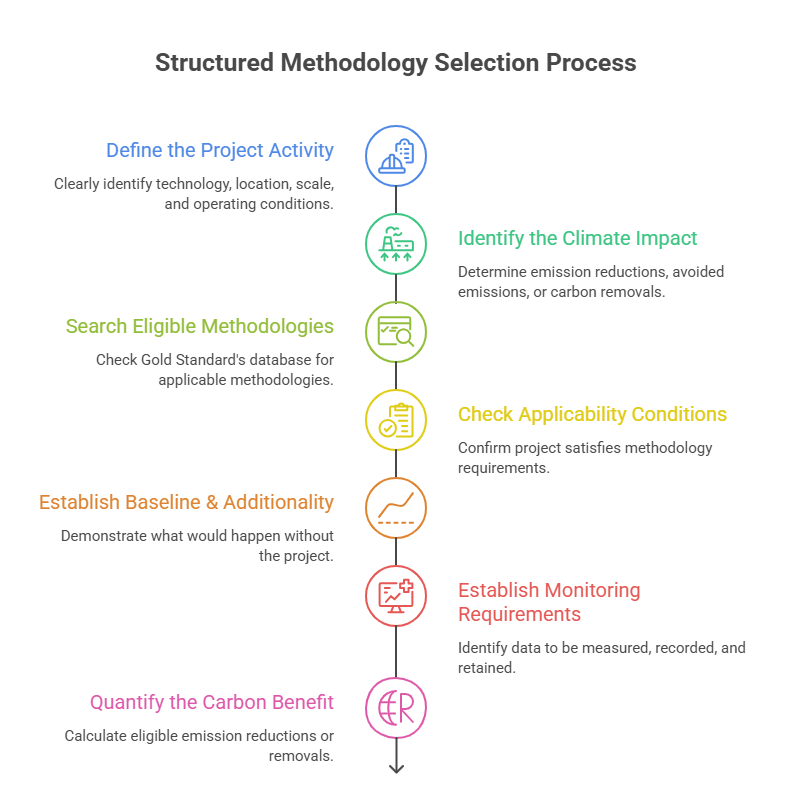
How Is the Right Methodology Selected?
Methodology selection should follow a structured process:
The Shift Towards Paris Agreement -Aligned Methodologies
Gold Standard is currently transitioning its methodology framework to align with the Paris Agreement.
Gold Standard states that Non-Paris Agreement-aligned methodologies are being retired and Paris Agreement-aligned methodologies are required for 2026-vintage issuances. It is also working with the UNFCCC process to republish relevant CDM methodologies under the Paris Agreement Crediting Mechanism (PACM).
This means project developers should not rely solely on historical CDM methodology references. They should verify the current Gold Standard methodology version, transition requirements and applicability before beginning project development.
Why Methodology Selection Matters?
Selecting the correct methodology determines:
- Whether a project is eligible
- How the baseline is established
- How additionality is demonstrated
- Which emissions must be accounted for
- How carbon benefits are calculated
- What monitoring data is required
- How the project will be verified
Therefore, carbon-credit development should begin with methodology and eligibility assessment—not simply with an estimate of potential carbon credits.
GS4GG Methodology Development
Where no suitable methodology exists, developers may explore Gold Standard’s Methodology Development and Approval Procedure for developing or revising a methodology.
The process can involve:
Concept → Methodology Development → Technical Review → Public Consultation → Approval
This provides a pathway for emerging technologies and innovative carbon-removal activities that are not adequately covered by existing methodologies.
Conclusion
GS4GG-approved and eligible adapted methodologies provide the foundation for measuring and verifying the climate impact of a carbon project. As methodologies and requirements continue to evolve, particularly with the transition towards Paris Agreement-aligned approaches, it is important to assess the latest applicable requirements before selecting a methodology.
The right starting point is to understand the project’s emissions, identify its potential climate impact and then assess the most suitable methodology and carbon-credit pathway.
How Revive Sustainable Can Help:
- GHG Emission Calculation: Scope 1 & Scope 2 emission assessment using our in-house carbon calculator and relevant emission factors.
- Carbon Reduction Assessment: Identifying major emission sources and potential areas for reduction.
- Carbon Market Advisory: Understanding suitable carbon-market pathways such as India’s CCTS, Verra, Gold Standard.
- Carbon Credit Development: Supporting project assessment, methodology selection, carbon-credit potential and the overall crediting process.
Measure your emissions. Understand your opportunities. Explore the right carbon pathway.