

Many small projects, one programme: how PoA opens carbon markets to communities.
Carbon projects often involve multiple small-scale initiatives, such as village cooperatives and farmer groups, making individual registration processes time-consuming and expensive. Nature-based projects add another worry: what if the stored carbon is lost to a fire or a flood? A presentation by the Bureau of Energy Efficiency (BEE), Ministry of Power lays out how India’s carbon market (ICM) plans to solve both problems with a Programme of Activities (PoA) procedure and rules for Ecosystem-Based Approaches (EbA).
Here are the essentials. This guide explains the programme of activities (PoA) procedure in the Indian carbon market, from the start to ecosystem-based approaches and the carbon buffer pool.
Key terms
- PoA (programme of activities): A framework that groups many similar projects under one programme
- CPA: Component Project Activity, an individual project inside the PoA
- CME: Coordinating or Managing Entity, the nodal body that runs the PoA
- NoE / ACVA: Non-Obligated Entity (the project proponent) and Accredited Carbon Verification Agency
- EbA: Projects that cut or remove emissions through conserving, restoring and managing native ecosystems, soil carbon farming, and wetland and coastal protection
1. Programme of activities: one umbrella, many projects
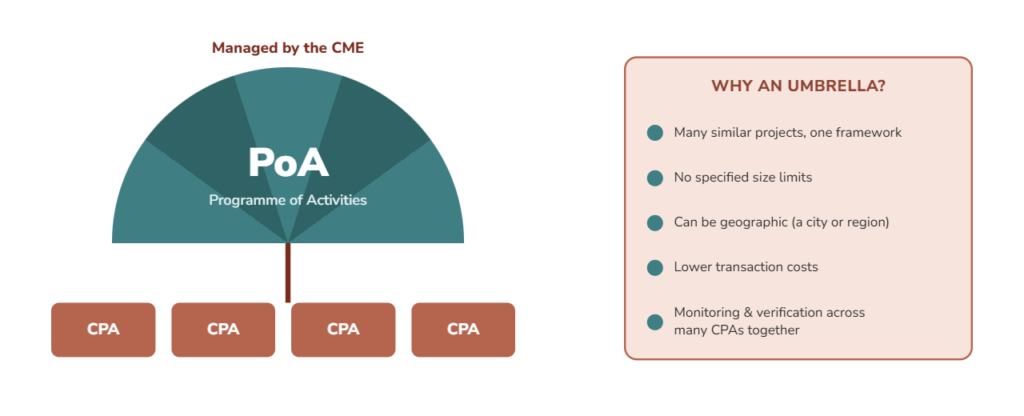
A PoA lets multiple similar project activities be administered under a single programme. Individual project developers are not directly engaged in the registration process; the CME registers and manages the programme on their behalf. The standard is meant to open the carbon market to individuals, communities, cooperatives and grassroots organisations by aggregating small-scale initiatives and channelling finance into low-carbon solutions.
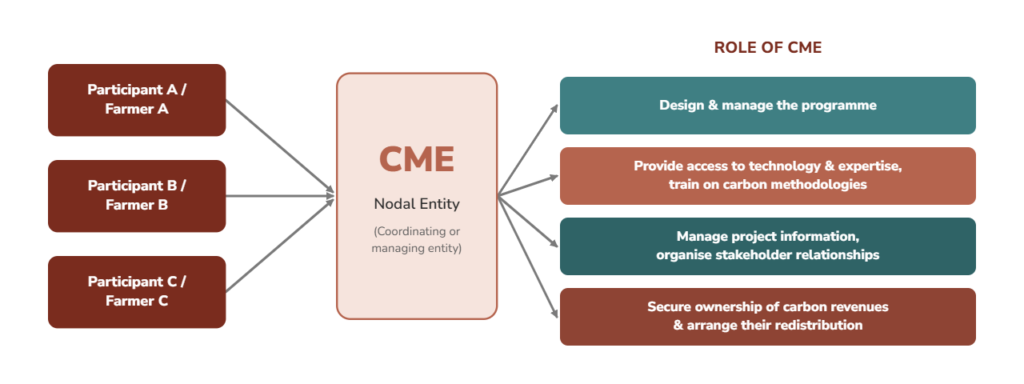
The CME: the programme’s nodal entity
The CME stands between participants (such as farmers) and the carbon platform, handling administration and monitoring so that participants do not have to.
2. The PoA journey in eight steps
The process runs from account registration to credit issuance. Responsibility is shared between the NoE, the ACVA and the ICM Administrator.
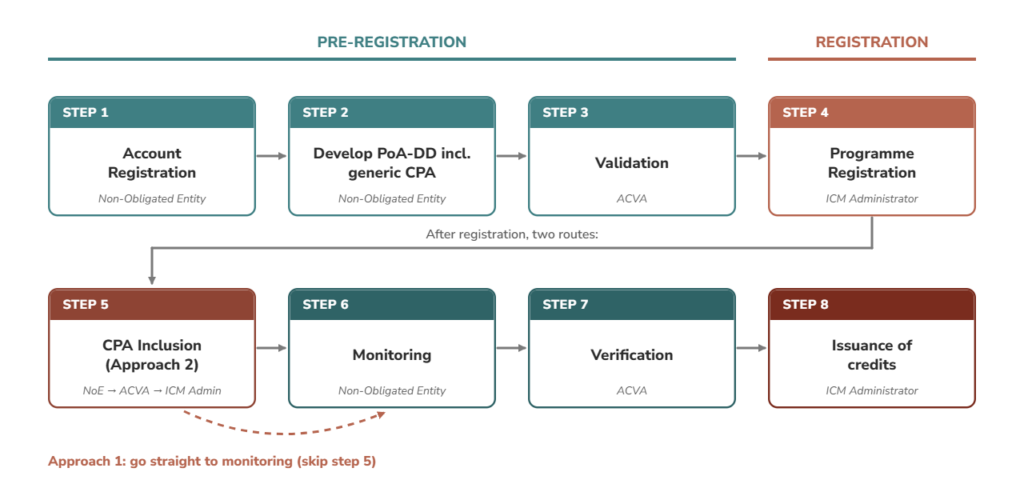
Reporting is flexible: the NoE may prepare one monitoring report for all CPAs in a batch, or separate reports for different batches, provided the batches share the same monitoring period and methodology version. Verification and issuance can then happen collectively or batch by batch.
3. Start dates and crediting periods
A CPA’s start date is when it began generating emission reductions, avoidance or removals. The PoA’s start date is the start date of its first generic CPA (the first project activity submitted in the PoA design document). The crediting period begins on the PoA registration date or the first generic CPA’s start date, whichever is later.
Ecosystem-based programmes get far longer timelines than standard ones, because forests and soils take time to deliver results:
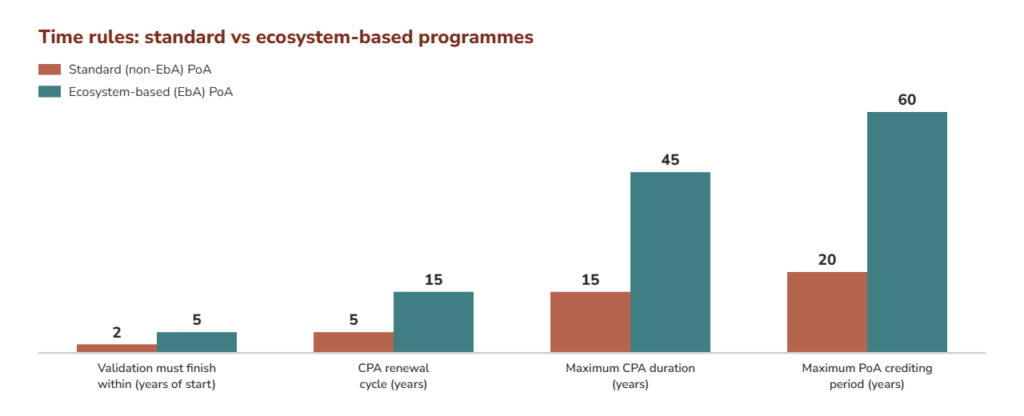
Renewals: standard CPAs renew every 5 years up to 15 years in total. EbA CPAs renew every 15 years, up to two times (45 years maximum). Each renewal needs an updated PoA design document aligned with the ICM Ecosystem-based Approaches text.
4. Ecosystem-based approaches: the proposed rules
For EbA project activities (outside the PoA framework), the methodology proposes a fixed crediting period of 20 years, or a renewable period of 10 years with up to two renewals (30 years in total). A renewal request must be filed within 2 years of the previous period ending, or it will not be granted. Validation must be completed within 5 years of the project start date.
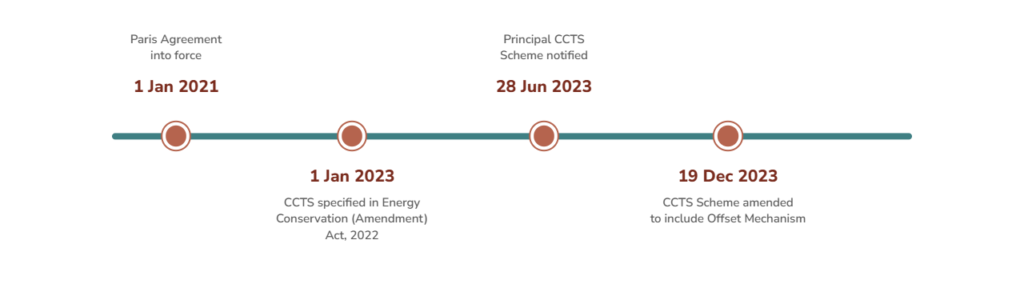
Proposed project start-date:
Definitions that matter
| Term | Meaning |
| Removals | Greenhouse gases taken out of the atmosphere through deliberate human activity and destroyed or durably stored |
| Reversals | A negative net change in stored GHGs, i.e. carbon released back to the atmosphere |
| Avoidable reversals | Caused by the factors NoE has influence or control |
| Unavoidable reversals | Caused by the factors NoE have no influence or control |
5. Permanence and the buffer pool
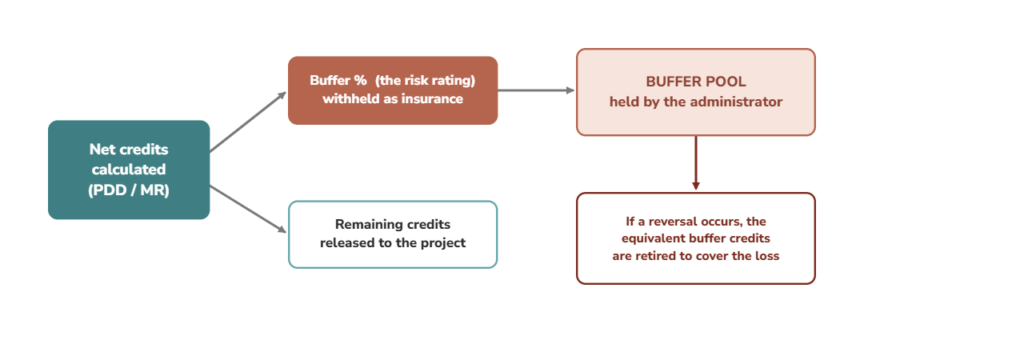
Permanence asks a simple question: Will the climate benefit last long enough to genuinely offset emissions elsewhere? The CDM handled this with temporary credits and long-term averages. The Paris Agreement Crediting Mechanism (PACM) and other voluntary standards use a buffer pool, which works like insurance: a percentage of credits is withheld by the administrator, and if a reversal happens, the equivalent buffer credits are retired to compensate for the loss.
6. How does the risk score decide the buffer?
A Non-permanence risk analysis sets how many credits go into the buffer. The NoE documents the scoring, and the ACVA verifies it during validation. Natural risk and project risk each carry 50% of the final score.

Every landscape carries its own mix of natural and project risk.
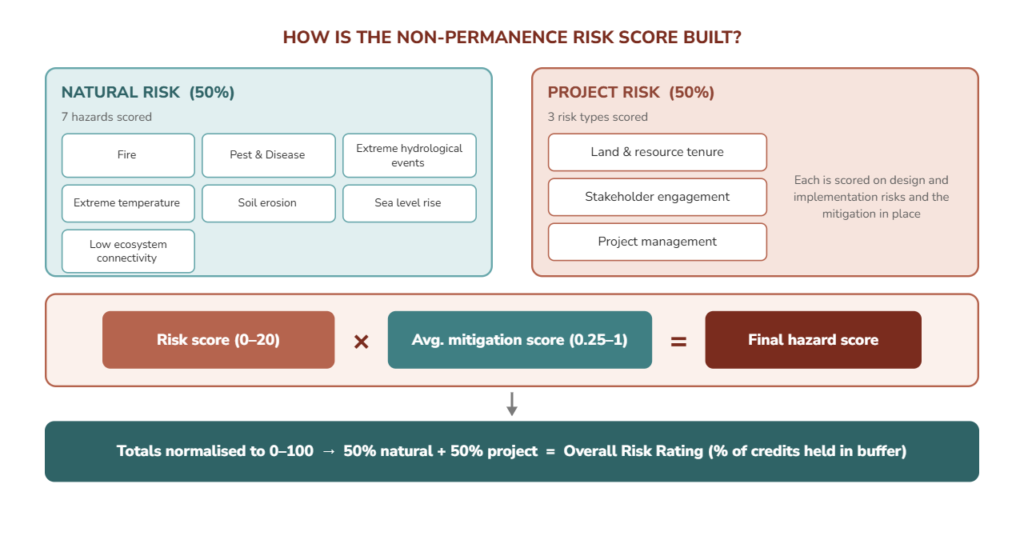
• Natural hazards (7): Fire, pests and disease, extreme hydrological events, extreme temperature, soil erosion, sea level rise and low ecosystem connectivity. Each is scored 0–20 from historical frequency and severity of carbon-stock loss, then multiplied by an average mitigation score (0.25 to 1)
• Project risks (3): Land and resource tenure, stakeholder engagement and project management, scored the same way.
• Overall rating: Total is normalised to 0–100 and combined 50:50. The rating is the percentage of the net carbon-stock change kept in the buffer (a rating of 35 means 35%).
Scoring Criteria – Overall Risk Score
- Fail line: a rating above 80% is unacceptably high and the project fails. Natural and project risk must each score below 80%.
- Floor: every project must carry a minimum risk of 15%.
7. Case Study: VCS 4485 Mejuruá, Brazil
This forest conservation project in the Amazonas state combines sustainable forest management on 130,641 ha with surveillance of the remaining 543,721 ha, while addressing local community needs and biodiversity conservation.
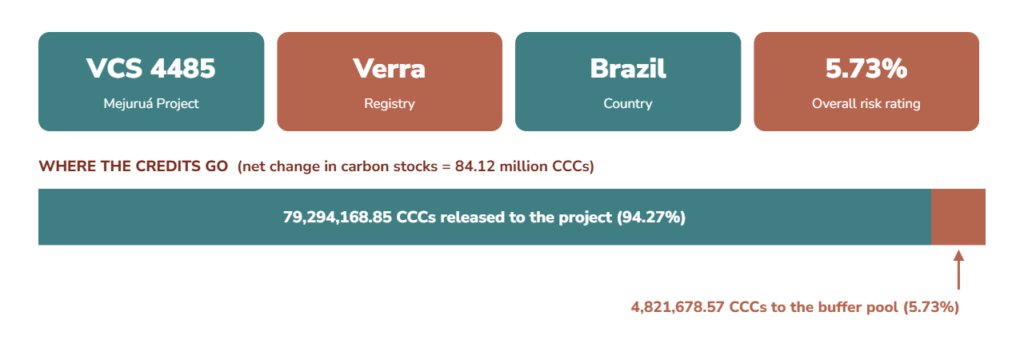
The normalised natural risk score (3.86) and project risk score (7.6) is weighted 50:50, giving an overall rating of 5.73%. Applied to the net change in carbon stocks of 84,115,847.42 CCCs, about 4.82 million credits go into the buffer pool and roughly 79.29 million are released to the NoE.
Note: This example comes from a Verra project. Its 5.73% rating is below the 15% minimum risk proposed for the ICM procedure.
Key takeaways
- A PoA bundles many CPAs under a CME, cutting transaction costs and opening the market to communities and cooperatives.
- The process has eight steps, with duties split between the NoE, ACVA and ICM Administrator.
- EbA programmes get longer timelines: up to 45 years of CPA crediting and 60 years for the PoA, versus 15 and 20 for standard PoAs.
- The buffer pool insures against carbon loss; its size comes from a 50:50 natural and project risk score.
- Proposed ICM guardrails: minimum 15% risk, and a project fails above 80%.
What would it take to meet your Carbon Goals?
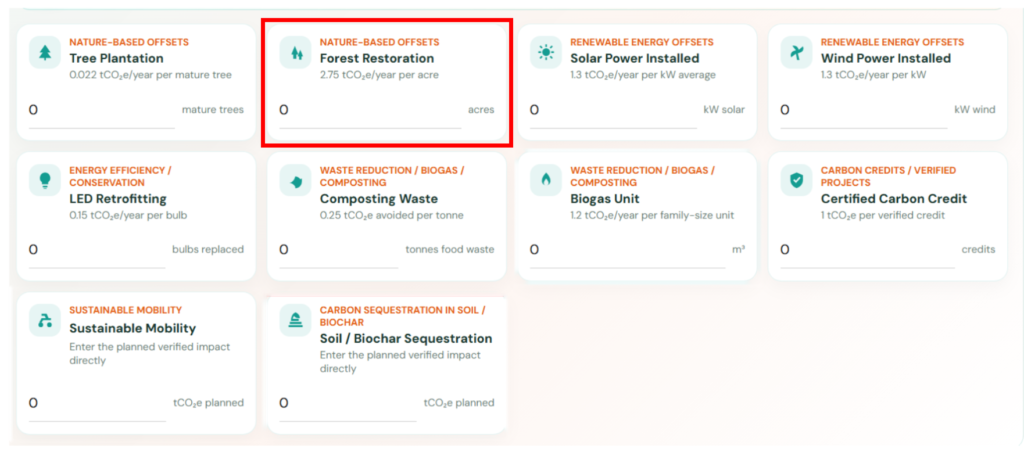
Wondering what your own restoration or plantation project could deliver? Try our in-house carbon calculator to estimate annual tCO₂e impact across nature-based, renewable energy, waste and soil activities.
Measure your emissions. Understand your opportunities. Explore the right carbon pathway.