

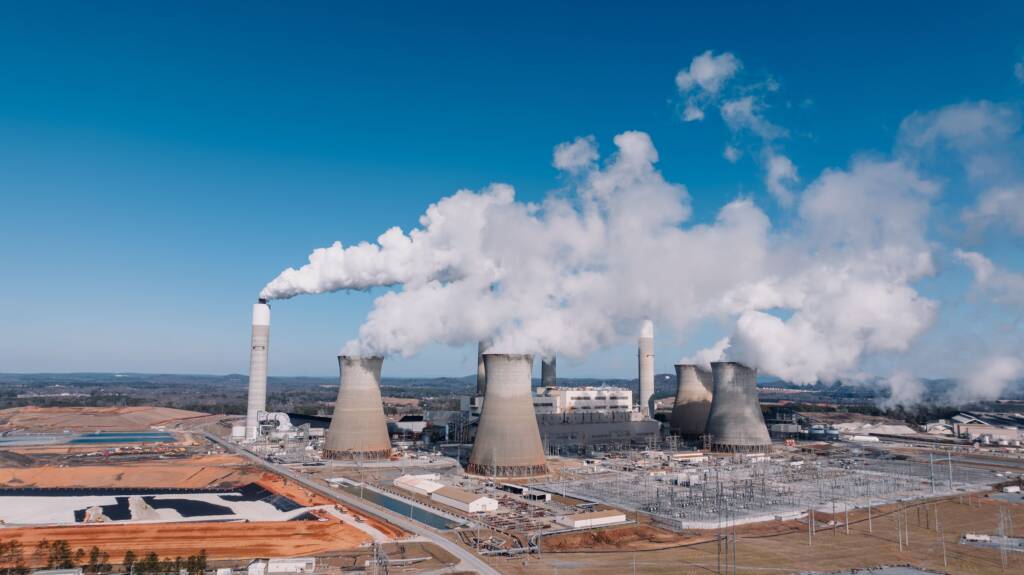
What if the CO₂ leaving a stack could be locked into building materials?
Accelerated carbon mineralisation can lock the CO₂ leaving a power plant, kiln or furnace into solid carbonate for use in construction. That is the idea behind BM CCU.001, a draft methodology developed by the Bureau of Energy Efficiency (BEE) that could open a new route to earn carbon credits in India. This blog walks through eligibility, project boundary, credit calculation, additionality and monitoring.
The idea in one picture:
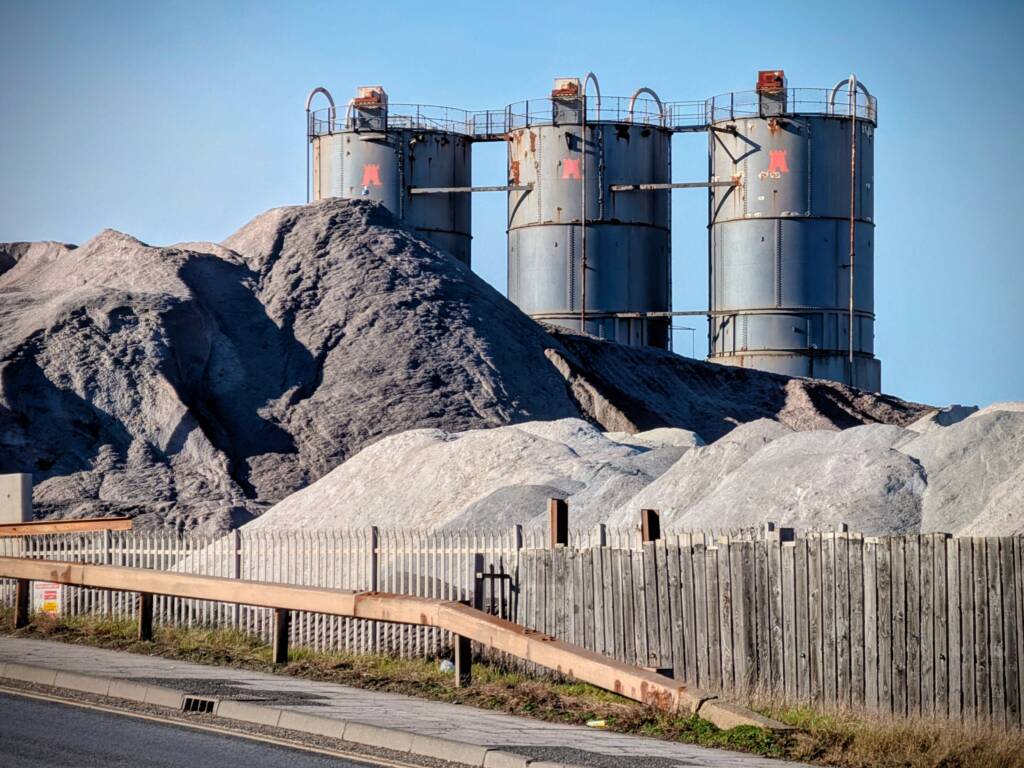
Industrial waste such as steel slag can be the raw material that locks CO₂ away.
Capture happens at source, after existing pollution controls. The CO₂ meets reactive alkaline waste, such as Electric arc furnace (EAF) slag, cement kiln dust or alkaline fly ash, with a small proportion of lime to activate capture potential. The result is solid carbonate that goes into durable construction or industrial materials.
How does Accelerated Carbon Mineralisation work?
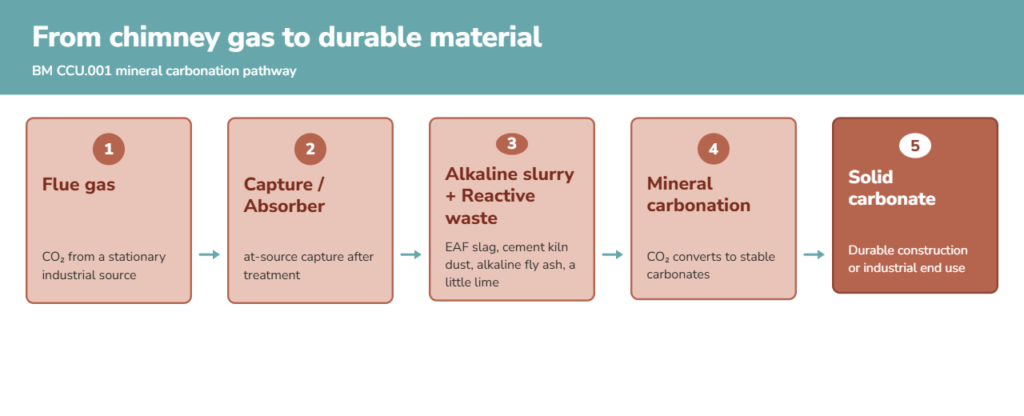
The mitigation action is a direct technological removal of CO₂ generated from fossil-fuel combustion flue gases. Under normal ambient conditions, the captured CO₂ is chemically converted into carbonate minerals with long-term storage and negligible reversal risk.
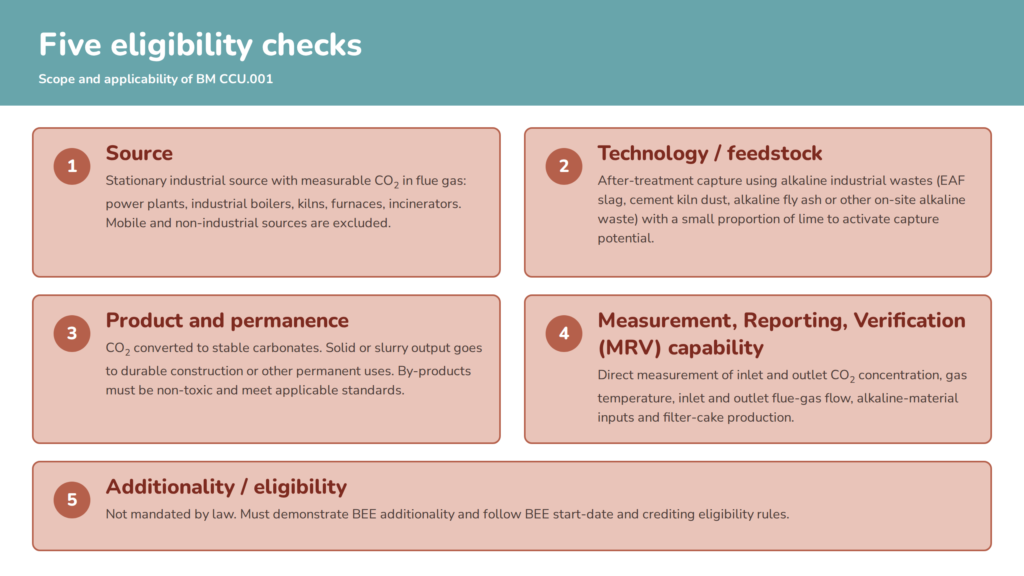
Five eligibility checks:
This methodology establishes five eligibility criteria to assess industrial CO₂ capture projects, covering source suitability, technology, product permanence, MRV (Measurement, Reporting, Verification) capabilities, and additionality requirements.
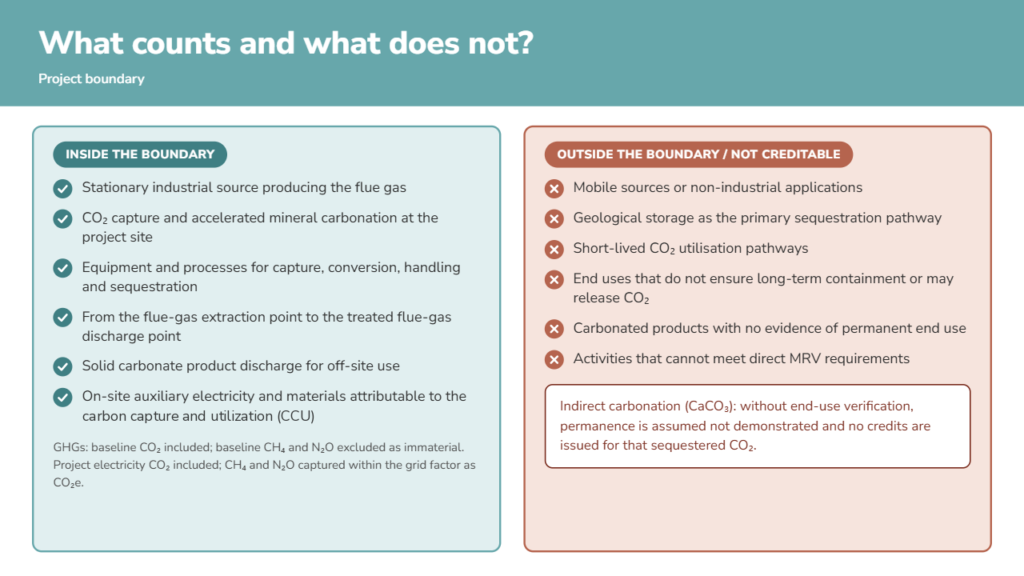
What counts and what does not count in the project boundary?
The project boundary runs from the flue-gas extraction point to the treated flue-gas discharge point, and extends to the discharge of solid carbonate product for off-site use. Anything that cannot show long-term containment falls outside it.
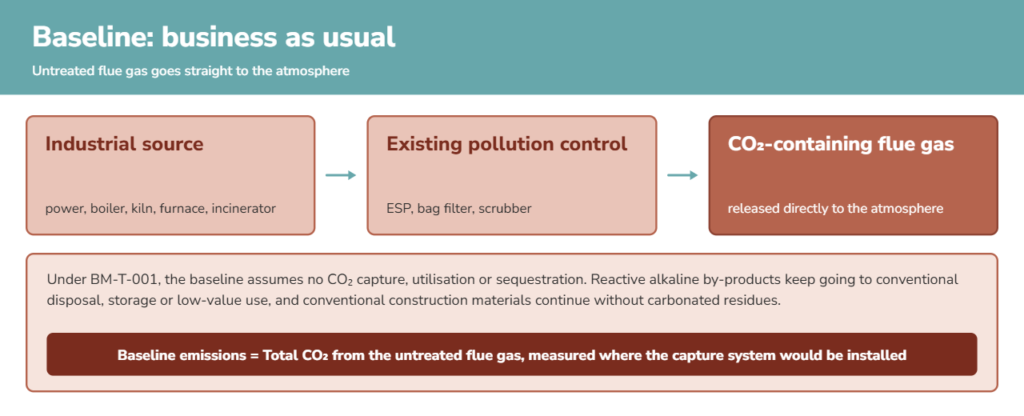
The baseline: Business as usual (BAU)
The baseline scenario assumes that CO₂-containing flue gases are released into the atmosphere after conventional pollution control, with no carbon capture, utilisation or sequestration. This serves as the reference point for assessing emission reductions achieved through the proposed project.
How are credits calculated?
Everything rolls up into one equation (Equation 13 in the draft Methodology):
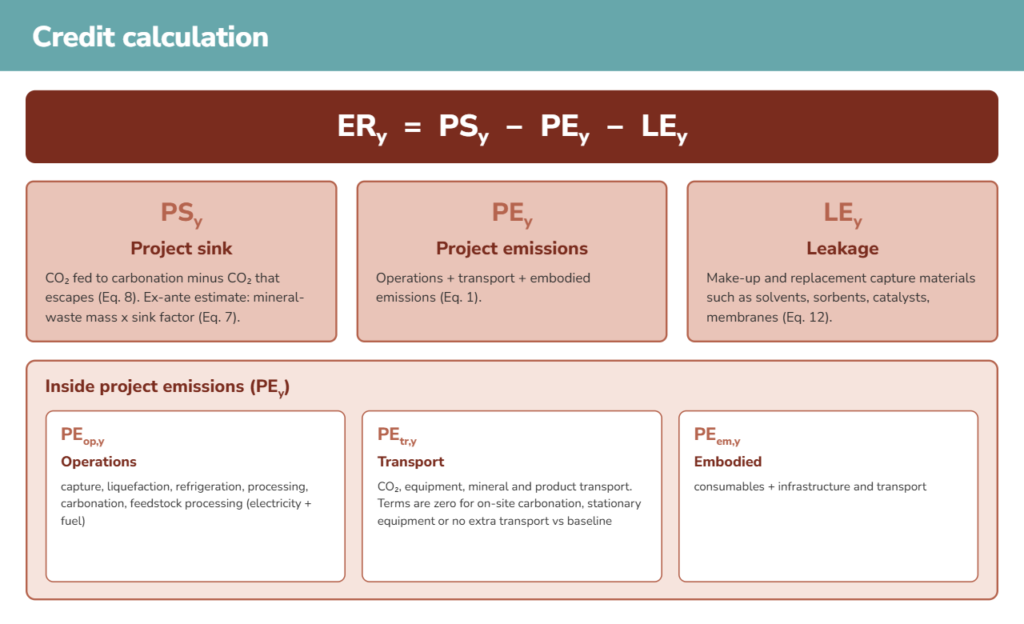
Step 1: The project sink (PS)
| Stage | Formula | How it works |
| Ex-ante (Equation 7) |  | Representative mass of mineral waste multiplied by a sink factor (tCO₂ fixed per tonne of waste), justified by experiments, industrial measurements, data sheets or literature. |
| Ex-post (Equation 8) |  | CO₂ fed to carbonation minus CO₂ that exits. In direct slurry carbonation, the loss can be negligible when inflow is optimised. In indirect carbonation, mlost is the measured outlet CO₂ (Equation 11). |
Step 2: Project emissions (PE) and leakage (LE)
• Operations: capture, liquefaction, refrigeration, processing, carbonation and mineral-feedstock processing. Electricity emissions use the grid emission factor under the latest CDM TOOL07 or the official grid factor.
• Transport: zero for the CO₂ term if carbonation happens on site, zero for equipment if stationary, and zero for mineral or product transport if there is no additional transport compared with the baseline. Freight uses CDM TOOL12.
• Embodied emissions: consumables plus infrastructure and transport.
• Leakage: make-up and replacement capture materials such as solvents, sorbents, catalysts and membranes, with production emission factors from approved commercial LCA tools or ISO 14040/14044 third-party LCA. Venting or fugitive CO₂ losses may also be accounted for here.
Proving additionality (BM-T-001 pathway)
| Step | What you must show |
| Regulatory surplus | The project is not required by national, state or local regulation. Existing rules focus on conventional pollutants (PM, SOx, NOx) and do not mandate CO₂ capture, mineralisation or permanent sequestration. |
| Barrier analysis | Carbon-credit revenue is instrumental in overcoming barriers. The four types are listed below. |
| Barrier | Examples from the draft |
| Technological | Specialised reactor, slurry and process control. Feedstock and flue-gas variability. Limited local operating experience. Continuous monitoring needed. |
| Financial / investment | Upfront cost of reactors, slurry handling, filtration and MRV infrastructure. Operating energy and material costs. By-product revenue alone is insufficient. |
| Institutional / market | No established market framework that specifically rewards permanent CO₂ mineralisation. Evolving standards, procurement and buyer acceptance. |
| Non-common practice | Accelerated mineral carbonation is novel in Indian power, cement, steel and other stationary-source sectors, with first-mover disadvantages. |
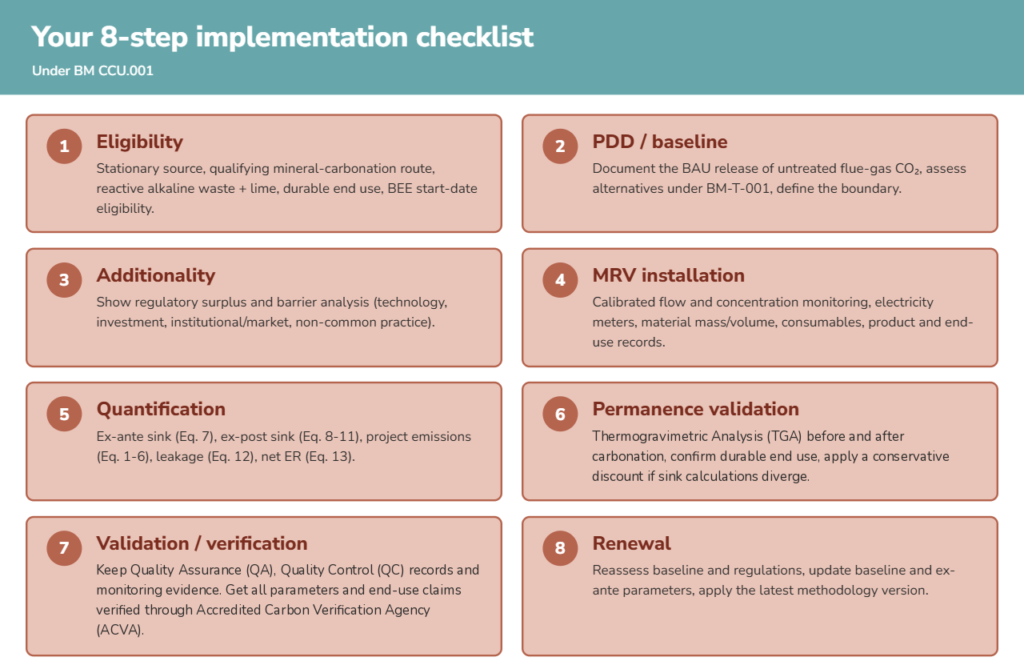
Your implementation roadmap:
It follows an eight-step process to ensure project eligibility, accurate emissions quantification, verification, and ongoing compliance for credible carbon credit generation.
Who should consider this methodology under the Offset mechanism?
• Power plants, industrial boilers, kilns, furnaces and incinerators with measurable CO₂ in flue gas.
• Cement, steel and other plants that already hold alkaline wastes such as EAF slag, cement kiln dust or fly ash.
• Technology developers piloting capture and mineralisation systems that can meet direct MRV.
• Construction-material producers who are able to prove a durable end use for the carbonate.
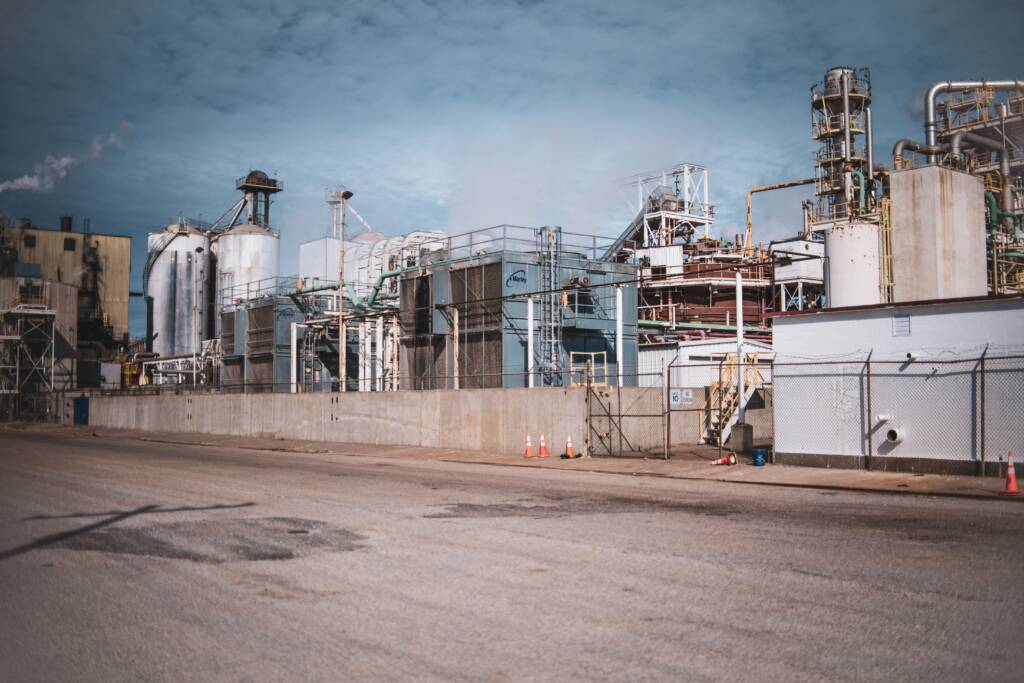
Emitters, waste holders, technology developers and material producers all have a role.
The bottom line
Accelerated carbon mineralisation links two problems: Industrial CO₂ and Industrial waste. The draft rewards projects that can measure every tonne going in and out, prove it has become a stable carbonate and show where it ends up. If your site has flue gas, alkaline waste and a durable end use, BM CCU.001 deserves a close look. Build your MRV plan first, because that is what decides whether credits are issued.
What would it take to meet your Carbon Goals?
Explore carbon sequestration, including accelerated carbon mineralisation, as an offsetting strategyand estimate your offsetting requirements using our in-house carbon calculator with many other offsetting options available to explore.
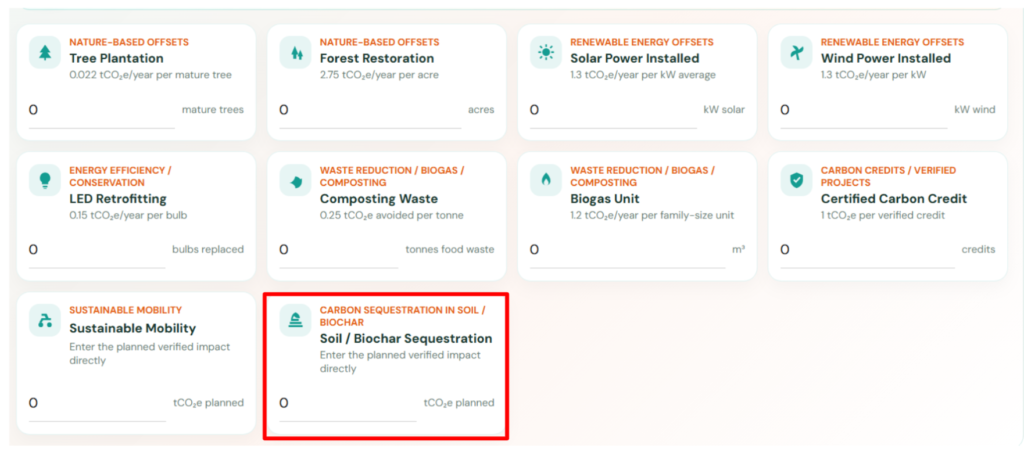
Measure your emissions. Understand your opportunities. Explore the right carbon pathway.